


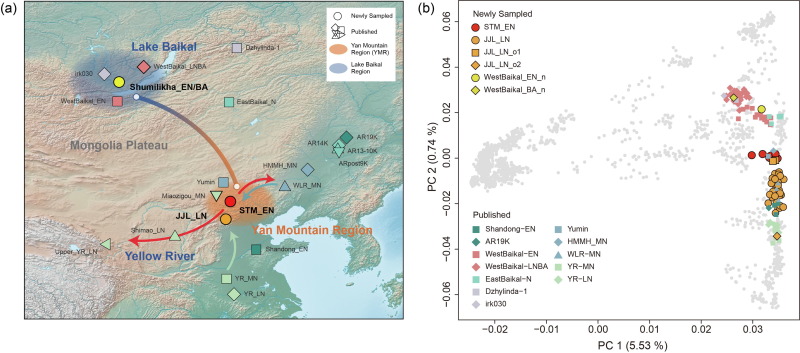
Scientists from Irkutsk State University in collaboration with Chinese colleagues have published data from a comparative analysis of the genomes of ancient populations from the Baikal region and the mountain region Yangshan (Northeastern China). The burials date back approximately from 7 700 to 4 300 years.
The results of the study have been published in the high-ranking Science Bulletin, a flagship journal of the Chinese Academy of Sciences.
This research is a key outcome of cooperation between archaeologists from ISU Research Centre “Baikal Region” and specialists from Jilin University (Changchun, China), which began over a year ago. The Irkutsk archaeologists conducted excavations on the Belaya River and provided their Chinese colleagues with samples from past excavations (two teeth from burials belonging to Early Neolithic hunter-gatherers (Kitoy culture) and Early Bronze Age hunter-gatherers (Glazkov stage)) for ancient DNA analysis. The results were obtained relatively quickly and, at the suggestion of the renowned paleogenetics specialist Professor Cui Yinqiu, were included into an article presenting a comparative analysis of the genomes of ancient populations from Northeastern China and Baikal region.
Ivan Berdnikov, Candidate of Historical Sciences and Deputy Director for Science at the Research Centre “Baikal Region”:
Our joint research differs from the multitude of studies in the field of ancient genomics that have recently been published in the leading scientific journals like Science and Nature. Those often present a collection of fragmented data with maximum geographical coverage but are largely detached from their archaeological context. We, however, focused on materials from closely located regions and concluded that a close connection existed between the ancient populations of Northeastern China and Baikal region. Extremely important for us, Irkutsk archaeologists, is the genetic similarity between an individual of the Kitoy culture from the Belaya River and the Early Neolithic population of the Yangshan region, as this connection is also supported by archaeological data. In particular, the Kitoy people and representatives of the Yumin culture shared similar pottery traditions, which involved making round-bottomed vessels decorated with impressions from woven nets. There are also some analogies in burial rites, including placing the deceased in a fetal position (though for the Kitoy people, this is rather an exception). Furthermore, the Early Neolithic populations of Baikal region and Northeastern China were united by a fondness for jade, which was considered a particularly valuable type of stone at the time and was used to make ornaments and specialized tools. All of this serves as evidence of cultural ties between the ancient inhabitants of these territories, which could have been a result of migrations, the exact nature of which remains to be clarified.
Thus, this work fills gaps in the research on the genome of ancient inhabitants of Northeast Asia and confirms some observations previously made based on the analysis of archaeological materials.


